
Overview
In 6 days from Cairo, explore the hidden wonders of Egypt with a unique tour through the Western Desert!
From the Bahariya Oasis to Minya, passing through the lunar landscapes of the White Desert and the little-known treasures of Meidum. Embark on an unforgettable adventure off the beaten track in a secret Egypt, far from the crowds, where history, silence, and the magic of the desert in bivouacs blend together.
An exceptional itinerary for those passionate about ancient Egypt, wide open spaces, and authenticity.
Highlights
- Departure from Cairo, arrival in Cairo
- Charming hotel, bivouac and 4* hotel
- Oases, desert, bivouac
- 5 nights / 6 days
Itinerary
Departure in the morning from your hotel in Cairo, towards the Bahariya Oasis (approximately 330 km, approximately 4 hours drive).
The Bahariya Oasis is one of the five oases that dot the Western Desert. It is located 330 km from Cairo, in a natural depression of 2,000 km2. It is a region renowned since the time of the pharaohs for its wine production. Today, date palms, olive trees, fruit trees, vegetables, and cereals are grown there. The Bahariya Oasis contains a wide range of natural resources, hot water, and important ancient monuments.
Check into your hotel and lunch in a typical restaurant.
Walk through the oasis to admire its traditional clay brick dwellings and date palm forests.
A swim in one of the oasis's many natural hot springs.
Climbing the Black Mountain (the English Mountain) . The summit of this mountain is a high point of the oasis, which allows you to admire a magnificent view of its strange landscape and enjoy a splendid sunset.
Dinner and overnight stay at the hotel
Breakfast at the hotel.
Departure to discover ancient sites in the Bahariya oasis:
The Museum of Golden Mummies , which contains some of the famous golden mummies discovered in the spectacular oasis necropolis in 2004. Mummies artfully wrapped in bandages are adorned with beautiful stuccoed and gilded cartonnage breastplate masks, characteristic of the Greco-Roman period.
The Temple of Alexander the Great , which was built by the very famous Alexander the Great in the 4th century BC, when this conqueror passed through here on his way back from the oracle of Amun-Zeus at the oasis of Siwa
The Chapels of Ain El-Muftalah date back to the 26th pharaonic dynasty, around the 7th century BC. They are dedicated to the god Bes, god of fertility. These chapels were carved into the rock and then painted.
Qaret Qasr Selim : an archaeological site containing two tombs with surprising colorful frescoes, dating from the 25th pharaonic dynasty.
Qaret El-Halwa ; contains the oldest tomb in the Bahariya Oasis; that of Amenhotep Hui, local governor under the new pharaonic empire and originally from the Bahariya Oasis. Dating from the 19th Dynasty
Lunch in a typical restaurant
Departure towards the White Desert (approximately 80 km), on the way you will discover:
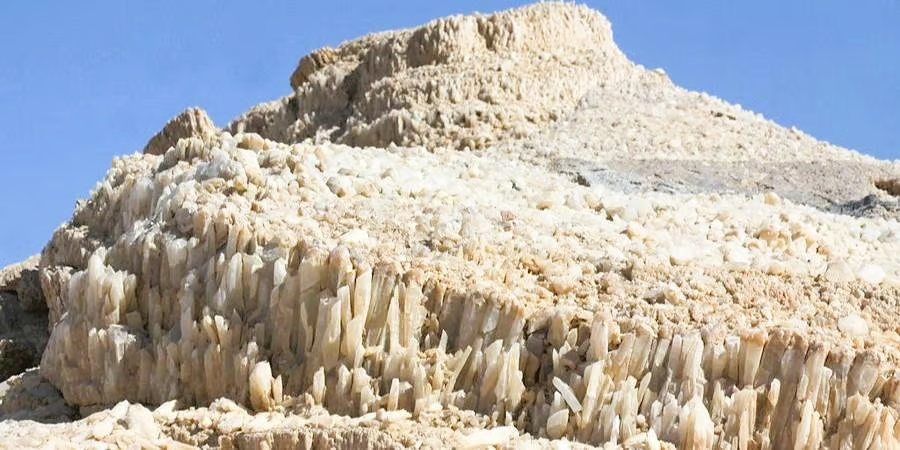
Crystal Mountain : One of the most beautiful attractions in the Egyptian desert, it is an arch-shaped rock mountain striated with quartz veins. It consists of a small natural arch in the rock and sparkling walls of calcite crystal. The crystals are oblong and either clear or opaque white. When the sun's rays hit the crystals, it is a dazzling sight.
Aqabat : a spectacular and truly sumptuous landscape. A vast cirque framed by mountains where you can admire the famous desert flowers; a type of black pyrite stone shaped by the wind and sand that takes the form of flowers.
You will take the road back to the white desert to arrive there at the end of the day.
The White Desert is a magical place unlike any other on the planet. It is a kind of vast depression that was covered by the sea millions of years ago. Today it is made up of chalk rock sculpted over a long period by wind erosion and characterized by dazzling white stone formations, hence the name White Desert...! There you can admire mysterious and also fanciful natural forms: mushrooms, pyramids, Sphinxes, towers, etc.
Barbecue dinner and overnight stay in a bivouac in the middle of the white desert .
You will enjoy the soft light when you wake up which highlights this magnificent landscape and the sublime sunrise in the middle of this unreal landscape.
After breakfast you can enjoy one last moment in this supernatural place.
Departure to the Black Desert which is a vast expanse of small black volcanic mountains of conical shape hence the name of the black desert given to this geological jewel. You can climb one of these mountains (Mount el-Zogag) to enjoy a beautiful view of the entire black desert and admire this rather special and not very lunar landscape.
You will take the road to Minya (180 km) in the Nile Valley
. Arrival in Minya in the early afternoon and lunch in a typical restaurant.
Check-in to your hotel
Minya is located approximately 240 km south of Cairo. This region boasts a stunning landscape distinguished by its authenticity and significant historical heritage. Suffice it to say that this was the region chosen by the very famous Pharaoh Akhenaten to establish his political and religious capital. It is a truly unusual destination, long neglected by tour operators, even though its assets could put it ahead of many other destinations in Egypt.
Dinner and overnight stay at the hotel.
Breakfast at the hotel and departure (with a packed lunch) for a day of sightseeing:
The Necropolis of Beni-Hassan , located about 20 km south of Minya on the west bank of the Nile, contains 39 tombs dating from the Middle Kingdom of the Pharaohs. This necropolis is located high up, with the facades of its tombs aligned on a terrace about a hundred meters long, overlooking the Nile Valley. All the tombs in this necropolis are rock-cut and carved into the limestone cliffs. Many of these large, spectacular tombs are exceptional for the quality and originality of their wall decoration. Some scenes depict episodes from daily life of the time, violent sports such as wrestling, or armed conflicts.
Temple of Istabl Antar : a small temple erected by the famous Queen Hatshepsut, located right next to the Necropolis of Beni-Hassan, about two kilometers away. It is characterized by scenes telling stories about the Hyksos invasion.
Lunch break and return to the road towards Amarna , about 25 km further south of the previous visits.
Amarna (the city of Akhetaten) is located about 25 km further south (45 km south of Minya) on the west bank of the Nile.
This place contains the remains of the city of Akhetaten (the horizon of Aten) founded by the mythical pharaoh Akhenaten who established the god Aten as the sole god of all Egypt. It was in this mythical place that an exceptional episode in the pharaonic history of Egypt took place. The historical site of Amarna is very extensive, it runs along the Nile for about 3 km. It consisted of a huge royal palace, two temples and numerous houses. It also contains a vast necropolis consisting of 25 tombs for high officials, all cut into the rock.
Return at the end of the day to your hotel in Minya.
Note : These routes also allow you to enjoy the alternation of fantastic and varied landscapes, city landscape, agricultural landscape and desert landscape.
Dinner and overnight stay at the hotel.
Breakfast at the hotel and departure (with a packed lunch) for a day of sightseeing:
Tounah el-Gebel is located about 50 km south of Minya on the east bank of the Nile, in the desert plain that runs along the foot of the cliff of the Western Desert. It is a spectacular city of the dead containing several tombs, the most important of which are:
- The tomb of Petosiris characterized by painted reliefs perfectly illustrating the composite art of the period where purely Egyptian motifs are associated with the Greek style which highlights the fluidity of gestures and the diversity of forms more natural than those of the classical canon.
- The tomb of Isadora which dates from the year 120 AD and which still preserves its mummy in good condition. According to tradition, it is the tomb of a young girl (Isadora) drowned in the Nile, victim of a romantic and dramatic love story!
- The tomb of Neith : It dates from the Roman period, in the first century BC. In which we admire the realism of the painted scenes and clearly Hellenistic.
The historic site of Tounah el-Gebel also features the Animal Catacombs . This is a spectacular underground necropolis of ibis and baboon mummies, the sacred animals of the god Thoth, to whom the site is dedicated. There is a four-meter-wide staircase leading to the three main galleries, which contain cavities housing the mummified animals in stone and pottery sarcophagi.
Lunch break and then back on the road to Achmounien.
Achmounien is located two kilometers from the previous site of Tounah el-Gebel. This archaeological site houses the remains of the ancient city of Hermopolis, which was one of the great religious centers of Pharaonic Egypt. Dedicated to the god Thoth, the god of wisdom.
Here, you can admire the remains of the once fortified city, delimited by a 15m-thick wall surrounding the great temple dedicated to Thoth. Two colossal baboon statues stand at the entrance to the site, symbolizing the god Thoth.
The archaeological site of Achmounian also features the remains of a Roman basilica and its covered market (Agora) with beautiful columns with Corinthian capitals, as well as the remains of two small temples of Seti I and Ramses II, built from limestone blocks with original reliefs on the monuments of Akhenaten.
You will return home at the end of the afternoon.
Dinner and overnight stay at the hotel.
Breakfast at the hotel and departure (with a packed lunch) for a day of sightseeing:
Deir el-Adra (the monastery of the virgin) is located about 20 km north of Minya. This monastery is dedicated to the Virgin Mary. Built on the cliff overlooking the west bank of the Nile, it is located within a square enclosure of Roman architecture. The chapel is partly excavated in the rock. This monastery was founded in the 4th century by Saint Helena, mother of the Roman Emperor Constantine, at the site of one of the stops of the Holy Family during their flight to Egypt. The church contains some beautiful icons from the 16th century . Many pilgrims set up camp around the monastery during the great annual feast of the Virgin Mary, which takes place in August each year.
Lunch break and return to the road to the pyramid of Meidum to visit:
The Pyramid of Meidum is located about 90 km south of Cairo. It was built by Pharaoh Snefru during the 4th pharaonic dynasty, around the 24th century BC. It is certainly the most curious of the pyramids because its architecture is a transition between those with steps and those with smooth slopes. The entrance to the pyramid is 15m above the ground.
Back on the road to Cairo, arriving at the end of the day .
Cost
The Cost Includes
- All transfers and travel during visits in a private vehicle.
- Private Egyptologist guide to ensure logistics and the visits mentioned.
- Entrances to the sites mentioned.
- Accommodation:
- - At the Bahariya Oasis: 1 night in a charming hotel.
- - At the White Desert: 1 night in a bivouac.
- - In Minya: 3 nights in a 4* hotel
- Full board stay (three meals a day)
- All service charges.
The Cost Excludes
- Any supplement not mentioned in the program.
- Tips for the guide and driver


