
Overview
3 Days Alexandria and Rosetta Tour
The 3 Days Alexandria and Rosetta Tour offers an exceptional opportunity to discover Egypt’s Mediterranean heritage. Throughout this 3 Days Alexandria and Rosetta Tour, visitors explore ancient monuments, impressive museums, historic streets, and remarkable architectural treasures. Whether you are passionate about history, culture, or photography, the 3 Days Alexandria and Rosetta Tour provides a unique and unforgettable travel experience. This carefully designed 3 Days Alexandria and Rosetta Tour combines the highlights of Alexandria and Rosetta in one fascinating journey.
Highlights
- Explore the legendary city of Alexandria, founded by Alexander the Great
- Visit the famous Library of Alexandria, one of the most important cultural landmarks in the world.
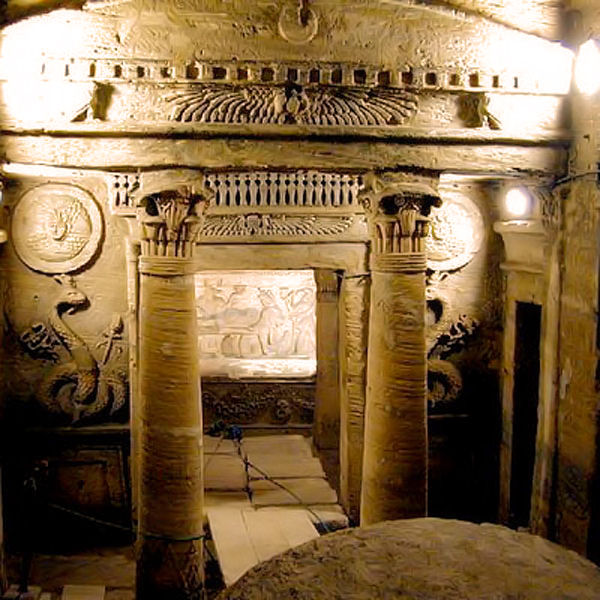
- Discover the fascinating Catacombs of Kom El Shoqafa
- Enjoy viewing the historic Qaitbay Citadel overlooking the Mediterranean Sea
- Visit Pompey's Pillar, one of the most prominent archaeological sites in Alexandria
- Wander among beautifully preserved Ottoman houses and historic streets
Morning departure to Alexandria 240 km west of Cairo to visit:
The Catacombs of Kom El-Chouqafa is a Roman necropolis discovered in 1907 in the center of Alexandria. It is a very extensive labyrinth composed of several parts:
The hypogeum (tomb dug in the basement) with the loculi (niches intended to accommodate the urns and sarcophagi of the deceased).
The funerary garden with the monuments decorated with scenes representing a mixture of Pharaonic art, Greek art and Roman art.
The Roman Theater and the remains of underwater excavations of the famous Lighthouse of Alexandria dating from the 4th century AD.
The theater was obviously not the only one in this ancient city, but it is the only one that was found. According to ancient texts, other theaters were built in Greek and Roman times.
Next to this theater are the foundations of a Roman villa, adorned with magnificent mosaic bird beds. It was therefore named by archaeologists "the villa of the birds".
Several statues exhibited on this site come from the underwater excavations around the lighthouse, led by the French archaeologist Jean-Yves Empereur.
The Serapeum and Pompey's Pillar is a site dating from Greek times, dedicated to the god Apis (represented in the form of a bull). This 15 meter granite column is on a height. It was erected in honor of the Roman Emperor Diocletian in 298 AD.
Lunch in a typical restaurant.
The current library of Alexandria is built on the site of the old library which was the most famous of antiquity. As at the time, it contains very important works. There are documents from all over the world, in all languages and on all subjects. It also houses several thematic museums.
Accommodation in a hotel in Alexandria.
Dinner and overnight at the hotel.
After breakfast at the hotel, departure for a day of excursion:
The Palace and Gardens of Montazah was erected in 1892 by Khedive Abbas Helmy. It was the summer residence of the ruling family at the time. The palace overlooks the sea and is located within a vast estate made up of magnificent gardens. This is the Montazah estate which extends over 150 hectares. There is a gentle atmosphere conducive to reverie, there are pretty beaches, avenues of palm trees, an ornate pink bridge as well as flowerbeds and elegant lawns.
The Royal Jewels Museum is a real gem displaying a sparkling collection of jewels that belonged to members of the last Egyptian monarchy before 1952. It is housed in a sumptuous old villa which is a curiosity in itself, with paintings Renaissance style and romantic style stained glass windows.
Breakfast in a local restaurant
The Fort of Qaietbey, this citadel dates from the medieval period, it is built on the site of the former very famous lighthouse of Alexandria.
The El-Mursi Abul-Abbas Mosque is dedicated to the Andalusian Sufi saint, El-Mursi Aboul-Abbas, who died and was buried here in the 13th century. It was rebuilt in 1929 by Italian architect Mario Rossi. It is the largest mosque in Alexandria. It is characterized by its cream facade, its four large domes, its arabesques and its immense minaret. You can also admire the colonnade of elongated arches, the eight massive granite columns and a magnificent marble floor.
Night at the hotel.
Breakfast at the hotel and departure for a day in Rosette.
Rosetta is a Mediterranean city located about 100 km west of Alexandria.
This is where the Nile flows into the Mediterranean. It is in this city that the famous Rosetta Stone was discovered, which gave it its name.
During the journey to Rosette, you can admire the landscape of the Nile Delta, it is agricultural Egypt, the vast cotton plantations, the houses covered with roofs of dried hay, etc.
You will visit :
The Citadel of Qaet bey dating from the Mamluk period (1497)
The city of Rosetta with in particular the visit of unique patrician houses reminiscent of those of Yemen. They are tall and relatively narrow. Their brick facades are punctuated by corbels and windows with moucharabieh.
Hammam Azouz , it is a hammam dating from the 19th century with marble rooms and perforated cupolas of colored glass.
The Moulin Abou Chahine which still retains its huge wooden presses
The National Museum of Rosette
Lunch in a typical restaurant.
Return to Cairo.
Price
The Price Includes
- Private air-conditioned vehicle for the day
- speaking Egyptologist guide
The Price Excludes
- Any supplement not mentioned.
- Tips for guide and driver
Frequently Asked Questions
Questions
The tour lasts 3 days and 2 nights, allowing you to explore the most important attractions of Alexandria and Rosetta at a comfortable pace.
The tour includes visits to the Library of Alexandria, Qaitbay Citadel, the Catacombs of Kom El Shoqafa, Pompey's Pillar, and the historic city of Rosetta.
Yes, accommodation for 2 nights is included according to the selected tour package.
Private tour options are available and provide personalized services, private transportation, and flexible scheduling.
We recommend comfortable walking shoes, sunglasses, sunscreen, a hat, a camera, and personal essentials.
Yes, the 3 Days Alexandria and Rosetta Tour is suitable for families, couples, solo travelers, and history enthusiasts.
Rosetta is known worldwide as the place where the Rosetta Stone was discovered, which played a key role in deciphering ancient Egyptian hieroglyphs.
The tour can be enjoyed year-round, but the most pleasant weather is usually between October and April.
The 3 Days Alexandria and Rosetta Tour combines ancient history, Mediterranean scenery, cultural heritage, and authentic local experiences, making it one of the best ways to discover Egypt's northern coast.