Itinerary
Departure in the morning from your hotel in Cairo towards the Oasis of Bahareya. After 3h30 drive:
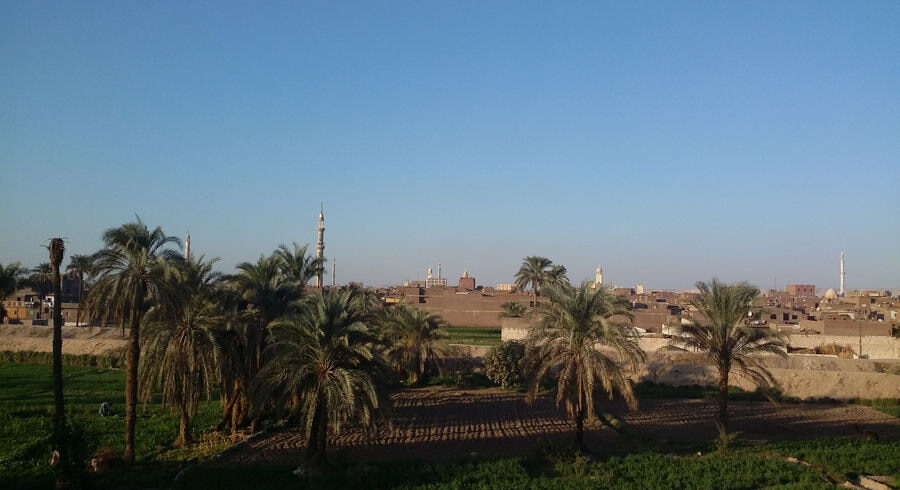
Bahariya Oasis is part of a string of oases that dot the Western Desert. Located 330 km from Cairo, in a natural depression of 2000 km2. It is a place well known since the time of the pharaohs, by its production of its very appreciated wine. Today there are nurseries of date palms, olive trees, fruit trees but also market gardening with vegetables and of course fields of cereals. It has many natural resources with hot water and many pharaonic monuments.
Installation in your hotel and lunch in a typical restaurant.
Walk in the oasis to discover its traditional clay brick dwellings and its immense expanses of date palms.
Bathing in a natural hot spring.
The day will end with the ascent of the Montagne des Anglais (or the Black Mountain) the highest point of the oasis which allows you to admire the magnificent view of this strange and wonderful landscape.
Dinner and overnight at the hotel.
Breakfast at the hotel.
Departure for the discovery of historical sites of the oasis of Bahariya:
The Golden Mummies Museum : housing some of the famous golden mummies discovered in the spectacular necropolis of the oasis in 2004. Mummies artfully threaded into bandages. These mummies are equipped with very beautiful mask-plastrons in stuccoed and gilded cardboard, characteristic of the Greco-Roman period.
The Temple of Alexander the Great : Built by the famous conqueror in the 4th century BC
The Chapels of Ain El-Muftalah : dating from the 26th Pharaonic dynasty, around 7th century BC. Consecrated to the god Bes, god of fertility. They were chiseled in the rock, then painted.
Qaret Qasr Sélim : An archaeological site containing two surprising tombs with their colorful frescoes, dating from the 25th Pharaonic dynasty.
Qaret El-Halwa : There is the oldest tomb of the oasis of Bahariya, the tomb of Amenhotep Hui local governor under the new empire and native of the oasis. She is from the 19th dynasty .
Lunch in a typical restaurant
You will take the road to the white desert (about 80 km) with stops to explore:
The Crystal Mountain : It is one of the most beautiful attractions of the Egyptian desert. A mountain of arch-shaped rock streaked with quartz veins. Consisting of a small natural arch in the rock and sparkling calcite crystal walls. The crystals are oblong in shape and either clear or opaque white. When the sun's rays hit the crystals, it's a dazzling sight.
Aqabat is a truly sumptuous landscape. A huge circus framed by mountains where you can admire the famous desert flowers, a kind of black pyrite stone shaped by the wind and the sand which take the form of flowers.
You will reach the white desert at the end of the day.
The White Desert is a magical place that has no equal on the whole planet, it is a kind of vast depression that was covered by the sea millions of years ago. It is now made up of chalky rock long sculpted by wind erosion and characterized by stone formations of dazzling whiteness, hence the name of the white desert...! You can admire mysterious and fanciful natural forms such as mushrooms, pyramids, Sphinxes, towers etc.
Barbecue dinner and night in a bivouac in the middle of the white desert
The soft light on waking will highlight this grandiose landscape thanks to a sublime sunrise in the middle of this unreal place.
After breakfast you will enjoy the last supernatural moments.
Departure to the Black Desert : a vast expanse of small conical volcanic mountains. It is the black color of these mountains that gave the name of the black desert to this geological jewel. Viou can climb one of these mountains (Mount el-Zogag) to admire a beautiful view of the black desert to enjoy a rather special and somewhat lunar landscape.
You will take the road to the Oasis of Dakhla (about 320 km) to arrive in the afternoon.
Dakhla Oasis is considered one of the most attractive of all Egyptian oases. It has more than five hundred natural hot springs as well as charming mud-brick dwellings and ruins. The oasis of Dakhla can hardly be considered as a single unit, it presents itself rather as a series of small scattered localities and hamlets. It offers beautiful landscapes and remarkable perspectives compared to all the oases of the Egyptian desert.
Lunch in a typical restaurant in Mut.
Walk to Mut which is the urbanized heart of the Oasis of Dakhla. This locality dates back to the time of the pharaohs since it was a colony of them. Then it became a medieval town where its doors were closed in the evening to protect the population from possible raids. You will enjoy the remains of the old town while strolling through its alleys and narrow streets.
Bathing in a natural hot spring.
You will take the road again towards the place of the bivouac: the natural lake of Qalamoun. You will enjoy a sublime sunset from the top of a dune which offers a spectacular panorama of the natural Qalamoun lake with its rugged surroundings.
Barbecue dinner and night in bivouac
Breakfast and departure for the visit of:
The village of Qalamoun : a medieval village characterized by its steep little streets, mud-brick houses with traditional doors. It is leaning on the top of a hill, which allows to have a panoramic view of all the surroundings.
City of Al-Qasr : medieval town designed in mud bricks. Consisting of narrow streets and secret passages; a real maze! The architecture of mud houses in these alleys and the narrow streets that are always cool despite the summer heat. Located at the foot of a limestone cliff and dominated by a historic mosque dating from the 13th century. The Nasr el-Din mosque , with its high minaret bristling with rough logs, recalls the minarets of black Africa.
Deir El-Haggar : Roman ruins found a few kilometers from the town of Al-Qasr. This archaeological site was already under the sand, which explains its extraordinary preservation. You can admire paintings dating from around 2000 years ago. Right next to this complex of Roman temples are conical-shaped hills that house several tombs, some of which have been excavated and others looted.
Bathing in a natural spring
Lunch in a typical restaurant.
Take the road to the Oasis of Kharga (180 km) and on the road stop to visit:
Village of Balat : medieval village in the traditional oasis style with undeniable charm. Some of its streets are painted blue. Its small narrow streets often covered with slightly low ceilings intended to protect the city from possible enemies by preventing them from entering it on horseback or on the back of camels.
La Montagne des Anglais : this place was a camping site for English troops during the 2nd World War. There you can admire graffiti left by soldiers of the time as well as the remains of their military devices such as topographic maps and others.
Teneda : a magnificent place in the middle of the desert where you can admire sand dunes and very captivating natural formations. You can also admire caves with very rare prehistoric drawings, sketching giraffes, antelopes and other Oisian fauna.
Join the Oasis of kharga at the end of the day.
The Kharga Oasis was an important transit point for the desert caravans that linked Egypt to southern Africa by the historic forty-day route. The oasis of kharga is characterized by the contrast between the greenery of the palm groves, plantations of fruit trees and the yellow ocher of the desert which offers a splendid view.
Installation of the bivouac in the village of Ganah where you will enjoy an unreal natural landscape and a sublime sunset from one of the surrounding hills.
Barbecue dinner and night in bivouac
Breakfast and departure for the visit of the main points of attractions of the oasis of Kharga:
The Temple of Hibis which is of significant importance as it represents different key stages in Egyptian history: Pharaonic, Persian, Greek and Roman. The Hibis Temple was built during the 26th Pharaonic Dynasty which was the last native dynasty to rule Egypt before the Persian conquest in 525. Most of the construction work was completed during the Persian occupation of Egypt, in particularly during the reign of Darieus 1 st . Dedicated to the god Amon, it is the best preserved archaeological site in the oasis of kharga.
The Bagawat Necropolis : Located northwest of the Hibis temple and is on the slope of a valley of about one kilometer. It is one of the oldest Christian necropolises in the world. The Bagawat Necropolis is made up of 263 raw earthen chapels in the Romano-Byzantine style. Some of these chapels preserve very beautiful frescoes of biblical scenes. It contains a church erected around the 4th century .
Qasr Ghweita (fortress of springs) is a temple-fortress dedicated to the worship of the holy triad: Amon, Mut and Khonsou. This archaeological site dates from the 6th century BC under the reign of Darius 1st . It is the only temple, with that of Hibis, which dates from the occupation of Egypt by the Persians. It stands on top of a hill which was originally the ruins of a pharaonic settlement.
Qasr el-Zayan : a temple dedicated to the cult of Amun Re of Hibis. It encloses a shrine made of white limestone blocks and several mud brick side chambers. It was erected in the Greek period and was enlarged in the Roman period.
Village of Barès is one of the urbanized centers of the oasis of Kharga. Made up of two small oases: Dakhakin and Gaga.
You will walk in these two small oases to savor the magical atmosphere of the desert which wins over these small oases through the sand dunes which vary from one meter to six meters high.
Bathing in a hot spring and lunch in a typical restaurant.
Return to Luxor (about 250 km)